Google's €13 Billion Finland Plan Just Hit a Permit Wall. Here's the Lesson for Every Site Buyer
Google committed €13 billion to Finnish data centers, then a regulator ordered work to stop at two sites. Power and money were never the problem. Permits were.

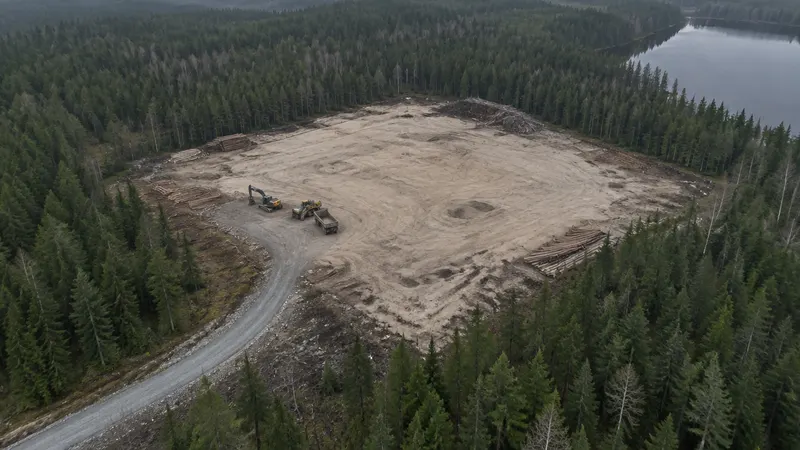
In September, Google announced at least €13 billion for data centers in Finland, its largest single investment in Europe. In October, Finland's regulator ordered its subsidiary to stop preparatory work at Muhos and Kajaani, because hundreds of hectares were cleared before the environmental impact assessment was done. The lesson for anyone buying or building a site, at any size: power is half of the deal. Permits are the other half.
Finland has become one of the most attractive places in Europe to build compute. Cold air, clean power and a stable grid have pulled in data centers for years. So when Google announced its biggest European investment there, nobody was surprised.
What happened four weeks later is the more useful story.
The plan: €13 billion and a lot of clean power
On 9 September 2026, Google said it would invest at least €13 billion in digital infrastructure in Finland over 2027 and 2028, according to its own announcement. The plan covers four locations: an expansion of its campus in Hamina, running since 2009, and new data centers in Kajaani, Muhos and Vaala.
The power side was carefully lined up:
- a 22-year power purchase agreement with Fortum, supporting the life extension of the Loviisa nuclear plant
- 629 MW of onshore wind through PPAs with Valorem and Suomen Hyötytuuli
- a new 94 MW battery near Kajaani, expected online in late 2027
- heat recovery designed to cover most of Hamina's district heating
On paper, this is what a well-prepared hyperscale project looks like: firm and clean power contracted years ahead.
The stop: hundreds of hectares cleared too early
On 6 October, Finland's Licensing and Supervision Agency ordered Google's Finnish subsidiary, Tuike Finland Oy, to suspend environmentally significant preparatory work at Muhos and Kajaani, as reported by Yahoo News and CNBC.
According to those reports:
- about 330 hectares at Muhos and just under 200 hectares at Kajaani had been cleared or prepared
- that is beyond the 200-hectare threshold where Finland requires an environmental impact assessment, and the assessment wasn't finished
- tree removal, excavation, blasting, soil moving and road building have to stop by 23 October
- the company had until 14 October to reply in writing
Google said it understood the concerns and acknowledged falling short of its own standards.
Why this matters beyond Google
Google is not short of money, lawyers or power contracts. If a project of this size can be held up by a permit, smaller projects certainly can.
We see the same pattern across the market:
- In the US, more than 100 data center moratoriums are under consideration, and Texas paused environmental permits for data centers while it audits power and water use. (We covered both in The Moratorium Map and Texas Paused Data Center Permits.)
- Communities are asking harder questions about land, water, noise and local benefit.
- Regulators are looking at what was done on site, not only at what was approved on paper.
The result: a site's value now depends as much on its permits and assessments as on its megawatts.
What to check before you buy or lease a site
Whether it is a 5 MW container yard or a 300 MW campus, ask for these in writing:
- Power today. Is power flowing now, at what capacity, and on what contract? Can the contract move to you?
- Permits in hand. Which permits are issued, and which are still pending? Get the documents, not a summary.
- Environmental assessment. Has the land been assessed for what you want to build? A permit for one use doesn't automatically cover another.
- What has already been done on site. Clearing, grading or building before approvals can create liabilities that pass to the next owner.
- Local rules. Zoning, noise limits and any moratorium under discussion.
- Timeline risk. What happens to the price if a permit or a grid connection slips?
Finland is still a strong market
None of this makes Finland a bad place to build. On our country profiles, Finland scores 78 out of 100: industrial electricity around 8.5 US cents per kWh (Eurostat, early 2026), a power mix that is about 96% clean (Ember, 2025) and mining that is legal under normal business rules. Hosting on our board in Finland starts at 4.4 cents per kWh.
The Google case simply shows what separates a good site from a risky one: not the price of power, but whether everything around that power is in order.
For buyers and owners
For buyers: pay for power you can verify and permits you can see. Tie payments to milestones when either is still pending.
For owners: if your site has energised power and its permits are in order, document it well. In a market where even Google can be told to stop, that paperwork is worth real money.
Compare sites and country profiles on the map at cryptosites.io, or list a permitted site through the listings desk.
CryptoSites.io is a marketplace for powered land, mining sites and hosting capacity worldwide. Facts in this article come from the public sources linked above as of 8 October 2026; the regulatory process is ongoing. This is not legal or financial advice.
Looking for a mining site or hosting?
Browse powered land, mining sites and hosting worldwide. A free account opens the full details of our highlighted sites.
Keep reading
All of Miners Digest →
Public Miners Unplugged Over a Billion Dollars of Machines. Here's Where the Power Went
Listed Bitcoin miners shrank their fleets in the first half of 2026 and wrote down about $1.1 billion of assets. The megawatts did not disappear. They moved, and that matters for anyone buying or selling a site.
Texas Paused Data Center Permits. Why Approved Megawatts Just Got More Valuable
Texas has stopped issuing environmental permits for new data centers while the state audits power and water use. For anyone buying or selling a Texas site, the gap between approved power and planned power just got much wider.
Beyond Bitcoin: Should Your Hosting Site Mine Zcash and Other Coins?
A large Zcash miner is placing a nine-figure order for new machines. Here's what multi-coin mining can and can't do for hosting providers and site owners, and how to decide if it belongs on your floor.