Public Miners Unplugged Over a Billion Dollars of Machines. Here's Where the Power Went
Listed Bitcoin miners shrank their fleets in the first half of 2026 and wrote down about $1.1 billion of assets. The megawatts did not disappear. They moved, and that matters for anyone buying or selling a site.

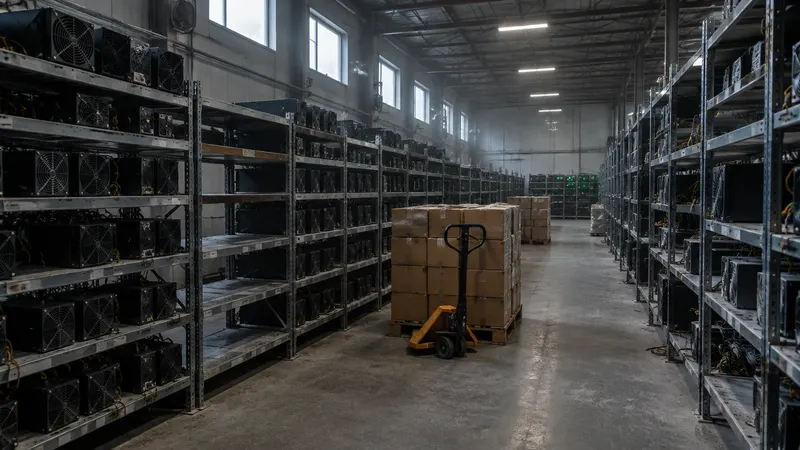
Listed Bitcoin miners lost an estimated 56 to 75 EH/s of realized hashrate in H1 2026, roughly $1.1 to $1.5 billion of machines at $20 per TH/s, and booked about $1.1 billion in impairments and held-for-sale markdowns. Most of that power is being redirected to AI and HPC. CoinShares has said listed miners could get as much as 70% of revenue from AI by the end of 2026. For the rest of the market, this means more megawatts changing hands, softer machine prices and a clearer split between sites built for AI and sites that are simply good for mining.
For years, the biggest listed miners were the biggest buyers of machines. In 2026 they became the biggest sellers of hashrate. The numbers came out in early October and were widely repeated. They are worth reading carefully, because the useful story is not the write-downs. It is where the power is going next.
What the numbers actually say
The headline figures come from Miner Weekly, the newsletter by BlocksBridge Consulting, republished by TheEnergyMag on 1 October and by Bitcoin.com News. Asian outlets, including MetaEra, relayed the same figures on 4 October.
According to that analysis:
- public miners lost about 75 EH/s of realized hashrate in the first half of 2026
- at an assumed $20 per TH/s, that is about $1.5 billion of machines, before buildings, electrical gear, cooling and installation
- across 12 tracked companies, asset impairments and held-for-sale markdowns came to about $1.1 billion
- IREN and Core Scientific made up almost 89% of that total, with IREN at roughly $695 million
One caution. The $1.5 billion is an estimate, not a figure from company filings. And the hashrate number is not consistent across Miner Weekly's own issues. The 3 September issue put the loss at 56 EH/s, a 15% contraction, while the network fell 10%. Using the more conservative 56 EH/s at the same $20 per TH/s gives about $1.1 billion of machines. Either way, it is a large fleet coming offline.
Not every write-down was about AI. TheEnergyMag notes that IREN's charges were tied to mining assets displaced by AI conversions, while Core Scientific pointed to weaker mining economics.
Why they cut: margins on one side, AI money on the other
Mining had a hard first half. CoinShares' Q2 2026 mining report says the quarter pushed the listed sector below cash breakeven in aggregate. Hashprice averaged an all-time low of $27.7 per PH/s per day in June. It has since recovered: Hashrate Index put spot hashprice at $39.87 on 28 September. (We looked at which sites still work at these levels in Hashprice Near $40.)
The other side is AI. CoinShares estimates that converting a site costs $8 to $15 million per MW, against $0.7 to $1 million for mining, but that AI earns about $1.5 million per MW per year versus about $0.5 million for mining. For a company that already holds energised power and can raise capital, that trade is hard to ignore.
The revenue mix is already moving. In its Q1 2026 report, CoinShares said listed miners "could derive as much as 70% of their revenues from AI" by the end of 2026, up from roughly 30% at the time. That is a projection, not a result. But by Q2, AI was already 71% of TeraWulf's revenue and 51.4% of IREN's, according to CoinShares. Miner Weekly reported that directly reported HPC and AI revenue across comparable miners rose 52% from Q1 to Q2.
So where did the power go?
Mostly, it stayed where it was. The substations, transformers and grid contracts did not move. What changed is what sits behind the meter.
- Into AI and HPC. CoinShares counts more than 4 GW contracted to AI and HPC across listed miners, but only about 550 MW actually billing. A lot of power is in the gap: committed to AI, but not yet earning from it.
- Out of mining for good. CoinShares says at least 35 EH/s is scheduled to leave the listed group. Keel stopped mining on 29 June, IREN plans to finish by 31 December 2026 and Cipher expects to exit by the end of 2027.
- Back to the market. IREN recorded a $102.1 million markdown on rigs held for sale, and Core Scientific paid $41.9 million to cancel about 15 EH/s of next-generation hardware. CoinShares expects some of that capacity may return to the market and soften rig prices.
Meanwhile, the network has not shrunk the way listed fleets have. CoinShares shows network hashrate falling from 1,066 EH/s at the start of the year (already below the late-2025 peak of about 1,110 to 1,150 EH/s, depending on the average used) to 879 EH/s in mid-July. Hashrate Index now puts the 30-day average at about 948 EH/s. Listed miners are shrinking, but someone else is still plugging machines in.
What this means for site buyers and owners
More megawatts will change hands. Listed miners are now sorting their sites into two groups: the ones worth converting to AI and the ones that are not. A site that is too small, too remote or on interruptible power is unlikely to become an AI campus. It can still be a good mining site. Expect more of those to be sold, leased out or offered as hosting. (We covered the conversion question in Mining Site or AI Data Center? The Conversion Math.)
AI sites and mining sites are not the same product. AI tenants want firm power, redundancy, fibre, water or advanced cooling, and usually a location near users. Mining wants the cheapest megawatt-hour and can live with curtailment. A 20 MW site with flexible, low-cost power and no fibre may be worth more to a miner than to an AI developer. Price your site for the buyer it actually suits.
Hosting capacity will shift. When a listed operator converts a building to AI, the mining machines inside it need a new home, or a buyer. That can mean more demand for hosting at sites that remain in mining, and more used machines looking for power. (See What Actually Drives Bitcoin Mining Hosting Prices in 2026.)
Smaller miners get a window. If CoinShares is right that rig prices soften, a smaller operator with cheap, reliable power can buy capacity for less than listed miners paid. The catch is the same as always: check the machines, check the hosting or power contract, and check the hashprice break-even before you commit.
The gap is a risk too. More than 4 GW contracted to AI against roughly 550 MW billing means a lot of projects still have to be built and financed. CoinShares also counts at least 225 data centre moratoriums or restrictions across 30 US states, with 151 still in force. Some AI conversions will slip. If you are buying power from, or selling a site to, a company mid-conversion, tie payments to milestones.
Questions to ask on any site that just left mining
- Is the power still energised, and is the utility contract transferable?
- Was the site designed for curtailment, and does the contract still allow it?
- Are the old machines included, sold separately or already gone?
- Do the permits cover the use you plan, mining or AI?
- If the seller is converting other sites, are there any shared assets or offtake commitments tied to this one?
For buyers and owners
For buyers: the listed miners' retreat from mining is your supply. Look for sites with energised power that are too small or too flexible for AI, and for machines coming back to the market. Verify everything in writing.
For owners: if your site has firm power, fibre and room to grow, an AI buyer may pay more. If it has cheap, flexible power and no fibre, sell it as what it is: a strong mining site. Both are in demand right now, from different buyers.
See where sites are on the map at cryptosites.io, or list or find capacity through the listings desk.
CryptoSites.io is a marketplace for powered land, mining sites and hosting capacity worldwide. Facts in this article come from the public sources linked above as of 9 October 2026. Hashrate and hardware-value figures are third-party estimates and differ between sources. This is not legal or financial advice.
Looking for a mining site or hosting?
Browse powered land, mining sites and hosting worldwide. A free account opens the full details of our highlighted sites.
Keep reading
All of Miners Digest →
Google's €13 Billion Finland Plan Just Hit a Permit Wall. Here's the Lesson for Every Site Buyer
Google committed €13 billion to Finnish data centers, then a regulator ordered work to stop at two sites. Power and money were never the problem. Permits were.
Texas Paused Data Center Permits. Why Approved Megawatts Just Got More Valuable
Texas has stopped issuing environmental permits for new data centers while the state audits power and water use. For anyone buying or selling a Texas site, the gap between approved power and planned power just got much wider.
Beyond Bitcoin: Should Your Hosting Site Mine Zcash and Other Coins?
A large Zcash miner is placing a nine-figure order for new machines. Here's what multi-coin mining can and can't do for hosting providers and site owners, and how to decide if it belongs on your floor.