What Does Proof-of-Work Actually Do?
Bitcoin miners spend real electricity to solve a puzzle that seems pointless. It isn't. Here's what proof-of-work does, in plain language, and why the energy is the point.

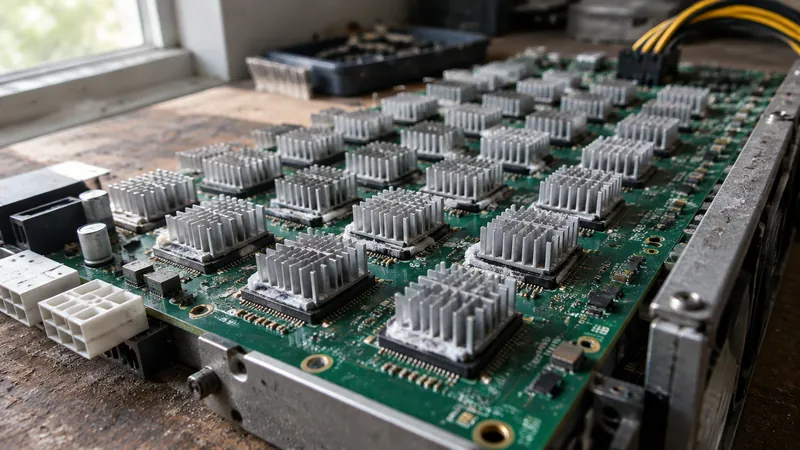
Proof-of-work is how Bitcoin agrees on one shared history without anyone in charge. Miners compete to find a number that makes a block's fingerprint start with enough zeros, which can only be done by trying billions of guesses. The winner adds the next block and gets paid. Because rewriting history would require redoing all that work, faster than everyone else combined, the energy spent is what makes the ledger expensive to attack.
People often describe Bitcoin mining as "computers solving complex math problems". That's not quite right, and it hides what's actually going on.
The problem Bitcoin has to solve
Bitcoin is a ledger that thousands of computers keep a copy of, with no bank or company in charge. That raises a hard question: if everyone has a copy, who decides which transactions go in next, and in what order? And how do you stop someone from spending the same coin twice?
Proof-of-work is Bitcoin's answer.
How it works, step by step
- Miners collect transactions waiting to be confirmed and put them into a candidate block.
- They run the block through a hash function called SHA-256. A hash is a fingerprint: any input produces a fixed-length string of characters, and the smallest change produces a completely different result.
- They look for a fingerprint below a target. The network requires the block's hash to be lower than a certain number, which in practice means it starts with a long run of zeros.
- There's no shortcut. The only way to find such a hash is to change one small field in the block (the nonce) and try again, billions and billions of times. That's what ASIC miners do: nothing but this, as fast and as efficiently as possible.
- The first miner to find a valid hash broadcasts the block. Everyone else can check it instantly with a single calculation.
- The winner is paid with the block reward plus the transaction fees, and everyone starts working on the next block.
Finding the answer is hard. Checking it is easy. That asymmetry is the whole trick.
Keeping the pace steady
Bitcoin aims for one block about every 10 minutes. Every 2,016 blocks, roughly every two weeks, the network adjusts the difficulty: if blocks came too fast because more miners joined, the target gets harder; if they came too slowly, it gets easier. That's why adding more machines to the network doesn't produce bitcoin faster. It only makes the network more secure.
Why the energy is the point
Each block includes the fingerprint of the block before it, so the blocks form a chain. To change a past transaction, an attacker would have to redo the work for that block and every block after it, and then outpace the rest of the network to make their version the longest chain.
That would require more computing power than all honest miners combined, plus the electricity to run it. The cost of attacking Bitcoin is tied to real-world resources: hardware and energy. The more hashrate the network has, the more expensive an attack becomes.
So the energy isn't wasted on a meaningless puzzle. It's the price of a ledger that no single party can rewrite.
What proof-of-work does, in short
- Orders transactions without a central authority.
- Prevents double spending, because every transaction is part of one agreed history.
- Makes history expensive to change, more so with every block added on top.
- Issues new bitcoin on a predictable schedule, as miners' reward.
- Lets anyone participate, with hardware and electricity, without anyone's permission.
Where miners fit in
Miners aren't just earning bitcoin. They're the security system. Every machine hashing honestly adds to the cost of attacking the network, and every block they add makes past transactions harder to reverse. That's why where mining happens, and on what power, matters to everyone who uses Bitcoin.
CryptoSites.io is a marketplace for powered land, mining sites and hosting capacity worldwide. This article is general information, not financial advice.
Looking for a mining site or hosting?
Browse powered land, mining sites and hosting worldwide. A free account opens the full details of our highlighted sites.
Keep reading
All of Miners Digest →
Which Mining and Crypto Conferences Are Worth It If You Buy, Sell or Host Mining Sites (2026-2027)
Not every crypto conference is useful for site deals. Here is where power developers, hosting buyers and mining capital actually meet, and how to turn a few days on the floor into real conversations.
Buying a Distressed Bitcoin Mining Site: What You Are Really Buying
Bankruptcy sales, lender foreclosures and motivated sellers can offer megawatts at a discount. The discount is only real if the power contract, the permits and the equipment title come with it.
The Moratorium Map: Where US Towns and States Are Blocking Mining and AI Data Centers
Cheap electricity and a grid connection are no longer enough. Local permission has become one of the biggest risks in any US site deal, and it can change faster than a power contract.