Mining Site or AI Data Center? The Conversion Math
Miners are signing multi-billion-dollar AI leases on sites built for ASICs. Here's what makes a mining site convertible, what it costs to get there, and what it means if you're buying a site or a used fleet.

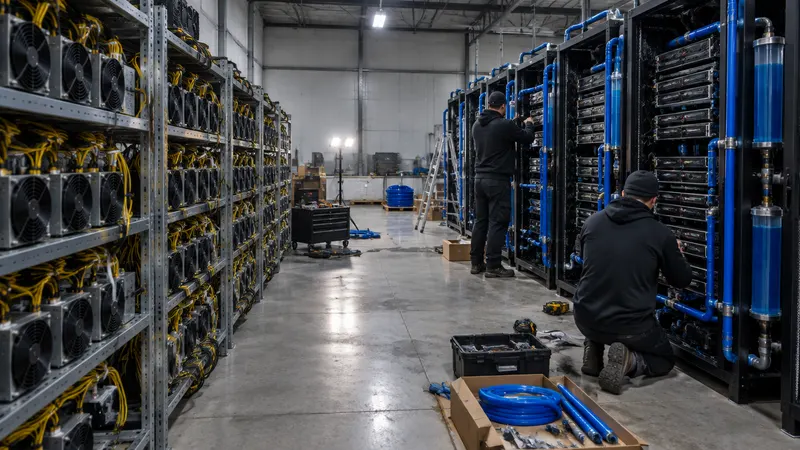
A megawatt sold to AI or HPC earns many times what the same megawatt earns mining bitcoin, and public markets now value miners with AI contracts at about twice the multiple of pure miners. But not every mining site can make the switch. Power and a grid connection get you in the door; floor loading, cooling, redundancy and fibre decide whether a deal is real. For most owners, leasing a ready shell is the lower-risk path.
A bitcoin mining site and an AI data center want the same first thing: large amounts of reliable power, already connected. That overlap is why so many miners are now in the AI business. It is also why buyers increasingly ask one question before any other: could this site host AI?
The deals behind the trend
Two recent examples show the scale.
Hyperscale Data ended bitcoin mining at its Michigan site and plans to sell its rigs. It signed a 20 MW lease with a neocloud for 10 years, with two optional 5-year extensions. Over 20 years that could be worth more than $1.2B. A further 32 MW option could lift the total above $3B. The site supports 340 MW, so the first deal uses only part of it. Its bitcoin holdings have fallen from about 1,006 to 215.
Riot Platforms agreed a 20-year deal to supply 191 MW at its Rockdale, Texas site to Anthropic, valued at about $9B. Data center revenue was already $33.2M of Riot's $167.2M total in Q1 2026.
The market has noticed. According to CoinShares data reported by CoinDesk, miners with HPC contracts traded at 12.3x enterprise value, against 5.9x for pure-play miners. The sector had $70B in AI and HPC contracts.
Why the numbers are so different
The gap comes down to what one megawatt-hour earns. Hashrate Index puts AI and HPC at $1,500 to $3,500 per MWh, against $50 to $150 per MWh for bitcoin mining.
That is a difference of more than ten times. It explains why a site that only just covers its electricity cost as a mine can become a valuable asset as a data center. It also explains why AI tenants accept 10 to 20 year terms: power that is ready now is hard to find.
What makes a mining site convertible
Mining sites were built to be cheap per megawatt. AI data centers are built to never go down. The gap between those two goals is the conversion work.
- Substation and redundancy. Mines often run on a single feed and can tolerate curtailment. AI tenants usually expect redundant power paths, backup generation and contracted uptime. Ask whether the substation can be extended to a second feed.
- Floor loading. GPU racks are far heavier than shelves of ASICs. Hashrate Index notes that in retrofits the binding limit is usually floor loading first, then cooling, then power distribution. A light steel shed or a container yard may need new slabs or a new building.
- Cooling. Air-cooled mining halls move huge volumes of outside air. Modern GPU racks are dense and often need liquid cooling to the chip. Sites already running immersion or hydro cooling have a head start on water and heat rejection, but not a finished system.
- Power distribution. Mining uses simple, high-density distribution to long rows of identical machines. Data halls need distribution designed around racks, with metering and redundancy at each level.
- Fibre. Bitcoin needs very little bandwidth. AI training and inference need high-capacity, low-latency fibre, ideally from more than one carrier. A remote site with one small line is a serious gap.
- Location. Stranded power far from users suits mining well. For AI, distance to fibre routes, skilled staff and, for inference, end users matters more.
- Uptime tier and paperwork. Tenants will ask for a design standard, a track record and a service level agreement. Mines rarely have these.
A site that scores well on power and land but poorly on the rest is still a strong mining site. It is just not a quick AI conversion.
Costs and risks
Conversion is not cheap or fast. Expect new buildings or floors, new cooling plant, extra electrical gear and fibre builds, and months of construction during which the site may earn little. Contracts with AI tenants are long and detailed, and a tenant may only sign once a firm delivery date is possible.
There are also market risks. Demand for AI capacity has been strong, but long contracts depend on the credit of the tenant. A site that has dropped mining loses a revenue line that could have come back if bitcoin economics improve.
Lease the shell or operate the GPUs?
Owners have two broad paths, and Hashrate Index describes the trade-off clearly:
| Model | What you sell | Capex | Risk |
|---|---|---|---|
| Landlord (lease the shell) | Contracted power capacity, priced per kW | Lowest | Lowest |
| Operator (run the GPUs) | GPU-hours to customers | Highest | Highest |
Most mining companies signing AI deals, including the two above, are landlords. They supply powered, cooled space and leave the GPUs, and the risk of keeping them busy, to the tenant.
What it means for site buyers
AI-convertible sites now carry a premium. A buyer is paying not only for today's mining income but for the option to sign an AI lease later. That option is worth more when the site has room to grow, as with Hyperscale Data's 340 MW site and a first lease of 20 MW.
When you value a site, price the mining case on its own first. Then treat AI potential as an upside you have checked, not one you assume. A seller who claims a site is "AI-ready" should be able to show the substation design, structural reports, cooling capacity and fibre routes.
What it means for the used-ASIC market
When a miner switches to AI, its machines usually come up for sale, as Hyperscale Data plans with its rigs. More conversions mean more used ASICs on the market, which can help buyers looking for affordable fleets. It also means more checking: machines from a site wind-down may have run hard for years. Our guide on how to buy used ASIC miners safely covers what to inspect.
Practical next steps
- Score the site on the seven points above before talking to any AI tenant.
- Get a structural survey of floors and a written view on cooling upgrades.
- Ask the utility about a second feed and future capacity.
- Map fibre routes and carriers near the site.
- Model the site as a mine and as a leased shell, side by side.
If you are comparing sites, start on the map at cryptosites.io. Click a country to see its electricity price, power mix, legal status and CryptoSites score. For the basics of judging any site, read how to evaluate a bitcoin mining site and why powered land is the scarcest asset in compute. If you own a site with AI potential, our site specialists can list it through the listings desk.
CryptoSites.io is a marketplace for powered land, mining sites and hosting capacity worldwide. Company figures in this article come from the public sources linked and may change. CryptoSites.io has no affiliation with the companies named. This article is general information, not financial or investment advice.
Looking for a mining site or hosting?
Browse powered land, mining sites and hosting worldwide. A free account opens the full details of our highlighted sites.
Keep reading
All of Miners Digest →
Which Mining and Crypto Conferences Are Worth It If You Buy, Sell or Host Mining Sites (2026-2027)
Not every crypto conference is useful for site deals. Here is where power developers, hosting buyers and mining capital actually meet, and how to turn a few days on the floor into real conversations.
Buying a Distressed Bitcoin Mining Site: What You Are Really Buying
Bankruptcy sales, lender foreclosures and motivated sellers can offer megawatts at a discount. The discount is only real if the power contract, the permits and the equipment title come with it.
The Moratorium Map: Where US Towns and States Are Blocking Mining and AI Data Centers
Cheap electricity and a grid connection are no longer enough. Local permission has become one of the biggest risks in any US site deal, and it can change faster than a power contract.