How AI Can Optimize Bitcoin Mining (and Where It's Just Hype)
From per-chip tuning to pool selection, power-price forecasting and predicting failures, here's where data-driven automation genuinely helps miners today, and where "AI mining" is a sales pitch.

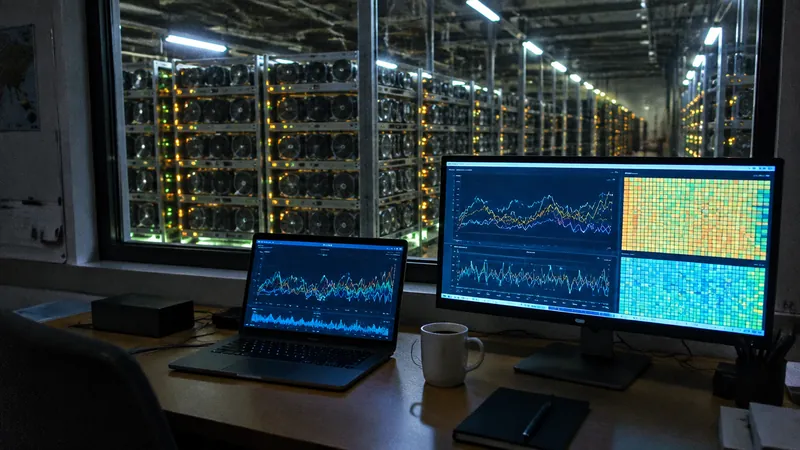
The most useful "AI" in mining today is unglamorous: firmware that tunes every chip individually, software that adjusts machines to hashprice and power prices, monitoring that spots failing machines before they die, and tools that compare pools on fees, payout method and stale shares. Together they can improve efficiency and uptime meaningfully. Anything that promises guaranteed daily returns because it's "powered by AI" is not optimization, it's a red flag.
"AI" is now attached to almost everything in mining. Some of it is real and useful. Some of it is marketing. Here's how to tell the difference, area by area.
1. Per-chip autotuning
Every ASIC chip comes out of the factory slightly different. Stock firmware runs them all at broadly the same settings. Autotuning firmware tests each chip and sets its own frequency and voltage, so stronger chips work harder and weaker ones run gentler.
Aftermarket firmware such as Braiins OS+, LuxOS and VNish offers this, and industry comparisons commonly report efficiency gains in the range of roughly 5 to 25% over stock settings, depending on the machine and conditions. These firmwares typically charge a small dev fee in hashrate, around 2 to 3%, which the efficiency gain usually more than covers.
This is the clearest win for most miners, and it's available today.
2. Tuning that follows the market
Some firmware and fleet software can change a machine's operating mode automatically when conditions change: running in an ultra-efficient mode when hashprice is low, and pushing harder when it's high. Fleet-level software can go further and switch individual machines off when their break-even power price is above the current price of power.
That's where data-driven decisions pay off: the right setting for each machine depends on hashprice, your power price and the machine's own efficiency, all of which change constantly.
3. Pool selection and switching
Mining pools differ in fees, payout methods and how reliable their servers are for your location:
- FPPS (full pay per share) pays a steady amount per share, including an estimate of transaction fees, so income is predictable.
- PPLNS (pay per last N shares) pays based on blocks the pool actually finds, so income varies more but can be higher over time.
- Latency and stale shares matter: a pool server far away can mean more rejected work.
Software can monitor fees, stale and reject rates and latency, and route hashrate to the best option, or fail over automatically when a pool goes down. The gains from constant switching are usually small for Bitcoin, but automatic failover and avoiding a badly performing pool can protect real revenue.
4. Predicting failures before they happen
A machine rarely fails without warning. Rising chip temperatures, fans spinning faster to keep up, small drops in hashrate on one board and more hardware errors all show up in the data first.
Monitoring systems that learn what "normal" looks like for each machine can flag the ones drifting toward failure, so technicians can clean, re-tune or repair them before they go offline. That's one of the most practical uses of machine learning in mining, because it directly protects uptime. (More on that in our uptime management guide.)
5. Power-price forecasting and curtailment
In markets where power prices change by the hour, such as Texas, forecasting prices and grid conditions lets a site decide when to run, when to curtail and when to offer flexibility to the grid for credits. Getting those decisions right can matter as much as the headline power rate.
6. Planning: when to buy, upgrade and sell
Researchers have started applying deep learning to the question of when buying mining hardware is likely to pay off, using hashprice, difficulty and hardware price data. Tools like this can support decisions, but no model removes the uncertainty of Bitcoin's price. Treat their output as one input, not a promise.
Where it's just hype
- "AI cloud mining" apps promising fixed daily returns. No algorithm makes mining revenue fixed. That's the classic cloud mining pitch with a new label. (See why most cloud mining is a scam.)
- Huge, vague performance claims with no test data, no machine model and no conditions.
- Black boxes you can't verify. Good tools show you what they changed and what it did to your hashrate, power use and revenue.
Where to start
- Measure first: hashrate, power use, temperatures and uptime per machine.
- Try autotuning firmware on a few machines and compare efficiency against stock.
- Set up pool failover and watch stale and reject rates.
- Add alerts for machines drifting from normal.
- Know your break-even power price per machine, and automate switch-offs around it.
The bottom line
The useful AI in mining isn't magic. It's careful measurement and automation applied to tuning, pools, power and maintenance. Used that way, it can make the same machines more efficient and keep them online longer. Used as a slogan, it's a warning sign.
CryptoSites.io is a marketplace for powered land, mining sites and hosting capacity worldwide. Products named in this article are examples, not endorsements; CryptoSites.io has no affiliation with them. This article is general information, not financial advice.
Looking for a mining site or hosting?
Browse powered land, mining sites and hosting worldwide. A free account opens the full details of our highlighted sites.
Keep reading
All of Miners Digest →
What the Bitcoin Halving Means for Mining, and How to Prepare for the Next One
Every four years, the reward for mining a block is cut in half overnight. Here's what that does to miners' revenue, which machines survive it, and what to do before the next halving around 2028.
Energy Sourcing for Bitcoin Mining in 2026: Options, Trade-Offs and Current Issues
Grid power, stranded gas, hydro and renewables each come with their own price, risks and politics. Here's how miners source power today, and the issues shaping where they can build.
Powered Land Is Becoming the Scarcest Asset in Compute
Chips can be ordered and buildings can be built. Megawatts on the grid can take years. That's why Bitcoin miners and AI builders are now chasing the same land.